

Why Choose Handcrafted Concrete Decor for Your Home
Table of Contents
- Why Choose Handcrafted Concrete Decor Over Mass-Produced Pieces
- The Benefits of Concrete Home Decor: Texture, Weight, and Warmth
- Sustainable Materials in Modern Concrete Decor
- Concrete Decor Durability and Care: What to Expect Long-Term
- Concrete Planters for Indoor Plants: A Practical Guide
- A Practical Buying Checklist for Handcrafted Concrete Decor
- Conclusion
- Frequently Asked Questions
Last Updated: October 18, 2026
Why Choose Handcrafted Concrete Decor Over Mass-Produced Pieces
Handcrafted concrete decor is functional art poured by hand in small batches, so no two pieces look identical.

Mass-produced concrete is poured into reusable molds by the thousand, and the uniformity is the problem.
The practical difference shows up in finish quality, weight, and design intent. Factory pieces are often thin-walled and hollow to cut shipping costs; handcrafted pieces are poured solid, giving them the heft that makes concrete feel substantial.
There's also the question of who made it. Buy from a small studio and you can ask about the mix, the sealant, and the care instructions and get a real answer, harder to do with a warehouse listing.
The Benefits of Concrete Home Decor: Texture, Weight, and Warmth
Concrete home decor brings a tactile, matte surface that softens a room instead of competing with it. The benefits come down to three qualities, texture, weight, and warmth, and understanding each separates a piece that works in a room from one that just looks good in a photo.
Texture: why matte reads calm
Concrete's surface is matte and slightly porous-feeling even when sealed, because the cement matrix and fine aggregate create a micro-texture that scatters light rather than reflecting it, the opposite of glazed ceramic or polished stone. In a room with glossy surfaces, a concrete piece acts as a visual resting point, strongest in neutral tones, sand, natural, bone, and blush, where the texture reads as organic rather than industrial.
Texture also changes with finish. Ask a maker which finish a piece has, because two pieces in the same color can feel completely different in hand.
Weight: the stability benefit nobody talks about
Weight matters more than people expect. A heavy piece has a low center of gravity and high friction against the surface, so it resists sliding when you set keys down or bump a candle. That stability is why concrete works so well as a catchall, centerpiece, or bookend, it stays where you put it, while lightweight decor migrates across a table.
Weight also signals construction. A solid-poured concrete tray or bowl has heft that a thin-walled factory piece cannot fake. When you pick up a piece, the weight tells you whether it was poured solid or hollowed out to save shipping cost.
Warmth: the surprise of neutral concrete
The common assumption is that concrete feels cold and industrial.
Styling matters here. Concrete reads warm next to natural fibers and warm-toned woods, and reads cooler next to chrome, glass, and cool white walls.
The American Society of Interior Designers' research on material and well-being consistently finds that natural textures and materials influence how calming a space feels, which is why matte, tactile finishes keep showing up in residential design.
How the three qualities work together
Concrete decor earns its place because texture, weight, and warmth reinforce each other: the matte texture calms the eye, the weight keeps the piece in place, and the neutral warmth fits farmhouse, boho, minimalist, and modern rooms without clashing.
Sustainable Materials in Modern Concrete Decor
Sustainable materials in modern concrete decor start with the mix. Cement is the carbon-intensive ingredient, and small studios pouring in limited batches waste far less material than factories running continuous production lines.
Here's the nuance most articles skip: concrete is heavy, and heavy means shipping emissions. A locally poured piece that travels a few states has a smaller footprint than an imported one, even if the imported piece uses a "greener" mix. Where it's made matters as much as what it's made of.
Concrete is also long-lived. The U.S. Environmental Protection Agency's guidance on reducing construction and demolition waste makes the same point about durable materials: the greenest product is usually the one you don't have to replace.
A few things to ask any maker:
- Where is the piece poured?
- Is the sealant non-toxic?
Concrete Decor Durability and Care: What to Expect Long-Term
Concrete decor durability and care come down to sealing and handling. A properly sealed piece resists staining and everyday wear for years, but it is not indestructible.
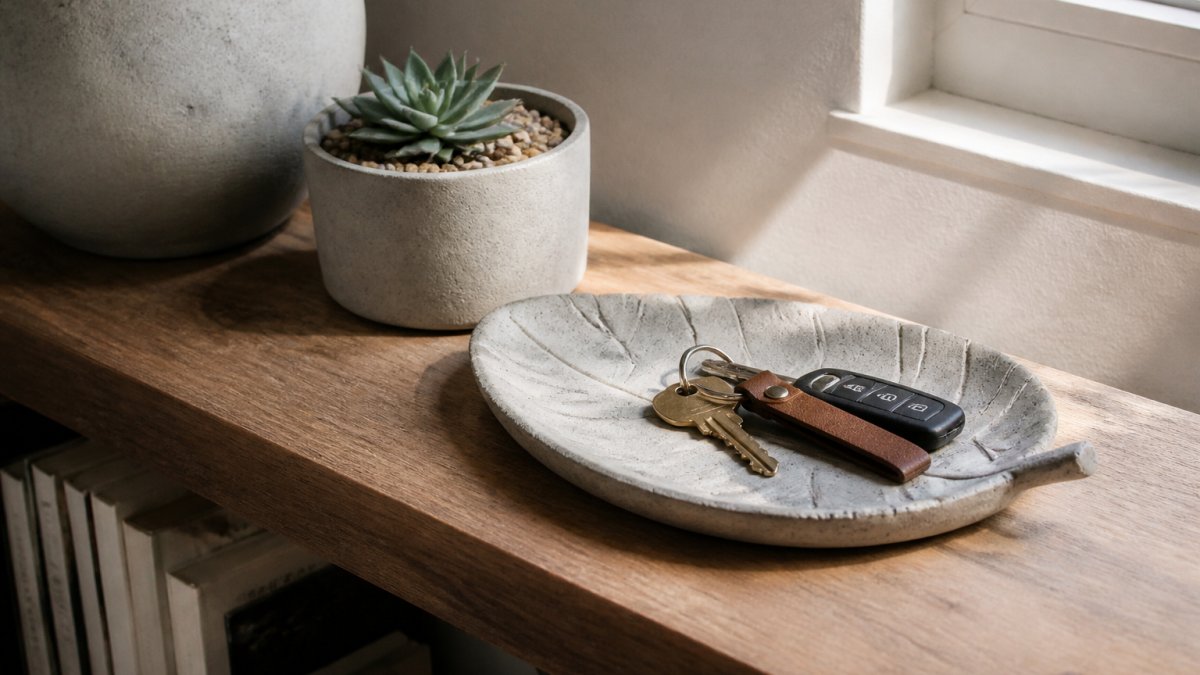
Handmade Concrete Leaf Tray, Fall Decor, Decorative Trinket Dish – Keys Jewelry →
Sealed concrete handles normal use well: keys, jewelry, candles, planters, and occasional moisture. What it doesn't like is thermal shock and hard impacts. Dropping a heavy piece on a tile floor, or moving a hot dish straight from the stove onto a sealed tray, can cause cracking.
Care is simple:
- Wipe with a damp cloth and mild soap
- Avoid abrasive cleaners and scouring pads
- Re-seal every year or two if the surface starts looking dull
- Use a cork or felt pad underneath to protect furniture
Small chips can be repaired with a matching patching compound, and hairline cracks are usually cosmetic. The Portland Cement Association's guidance on concrete durability notes that proper curing and sealing are the two biggest factors in how a concrete piece holds up over time.
Concrete Planters for Indoor Plants: A Practical Guide
Concrete planters for indoor plants work well for two reasons: mass and moisture behavior. A heavy vessel resists tipping and anchors tall plants, and the material's porosity creates a slow moisture exchange that many houseplants tolerate well. Getting the details right separates a planter that lasts from one that stains a shelf or rots a root ball.
Match pot size to root volume, not to the shelf
A common mistake is buying a planter sized to the room rather than the plant. Choose a vessel whose interior diameter is 1 to 2 inches larger than the nursery pot; going much larger leaves a wide band of wet soil that stays saturated longer than the roots can drink, a leading cause of root rot. For the visual mass of a large planter with a small plant, use the cachepot method.
Drainage: the cachepot method and when to drill
Most decorative concrete planters are poured without drainage holes because a hole complicates the pour and weakens the base. Treat the planter as a cachepot: keep the plant in its nursery pot, set it inside, and lift it out to water at the sink. This prevents both root rot and the mineral staining that occurs when water sits against an unsealed interior.
Liners, weight, and furniture protection
A 10-inch concrete planter can weigh 10 to 20 pounds empty, and a fully watered large planter can exceed 40 pounds. That weight is an asset for stability but a liability for furniture: use felt or cork pads under the base, and avoid glass tops, thin veneers, or floating shelves not rated for the load. For very large plants, a rolling caddy distributes the weight and lets you rotate the plant for even light.
Plant pairings that actually work
Succulents, snake plants, ZZ plants, and pothos are the most forgiving matches because they tolerate the slower drying cycle of a thick-walled concrete vessel. Ferns and calatheas prefer consistent moisture and do better in a glazed or lined container, or in a concrete cachepot. For anything thirstier, line the interior with a plastic nursery pot.
Seasonal care specifics
In winter, when indoor humidity drops and heating runs, concrete planters dry faster outside but the soil inside can stay wet longer because the walls insulate the root zone. Check moisture with a finger or meter rather than a schedule. Re-seal exterior surfaces every year or two if the finish dulls.
Our Concrete Bowl - Catchall Bowl - Succulent Planter is an 8-inch geometric bowl that works as a succulent planter or an entryway catchall. That dual use is the practical case for concrete planters: a piece heavy enough to stay put, neutral enough to fit any room, and versatile enough to earn its footprint.

A Practical Buying Checklist for Handcrafted Concrete Decor
A practical buying checklist keeps you from paying artisan prices for factory pieces. Run through these before you check out:
- Ask how it's poured. "Hand-poured in small batches" should be a specific claim, not a vague one.
- Check the sealant. Food-safe and non-toxic sealants matter for trays and bowls.
- Confirm the weight. Solid concrete should feel substantial, not hollow.
- Look for base protection. Cork or felt on the bottom prevents scratched furniture.
- Ask about color variance. Pigmented concrete shifts slightly between batches; a maker who tells you this upfront is being honest.
- Request care instructions. A good maker includes them.
| What to Check | Why It Matters | Red Flag |
|---|---|---|
| Pour method | Signals true handcrafting | Vague "artisan-style" language |
| Sealant type | Affects food safety and staining | No sealant info available |
| Weight and thickness | Indicates solid vs. hollow pour | Suspiciously light for its size |
| Base protection | Prevents furniture scratches | Bare concrete bottom |
| Damage policy | Protects a heavy, fragile shipment | No returns on shipped items |
Conclusion
Choosing handcrafted concrete decor is a decision about what kind of home you're building: one filled with pieces that have a maker behind them, or one filled with identical objects. We think the first is worth it, which is why every piece we pour at Cedar & Stone Garden is made in small batches in our own workshop, finished with a smooth sealed surface, and available in custom colors and laser engraving for gifts and corporate orders.
If you're ready to add something with real weight and texture to your space, shop all and find the piece that fits your room.
Frequently Asked Questions
Why choose handcrafted concrete decor over mass-produced decor?
Handcrafted concrete decor is poured in small batches, so each piece carries subtle variations in color, texture, and surface detail that mass-produced molds cannot replicate. That means no two pieces look identical. Handcrafted pieces also tend to use solid concrete rather than hollow resin or composite shells, giving them real weight and a tactile finish. The result is a decorative object with character, made by a person rather than a production line, which is why handcrafted concrete decor works so well as a gift or a focal accent.
Is concrete decor durable enough for everyday use?
Solid concrete is heavy and hard-wearing, and a sealed finish protects the surface from moisture and stains. A handcrafted concrete catchall or tray will handle daily use for keys, jewelry, or candles without issue. The main risks are dropping it on a hard floor and letting water sit on an unsealed surface. Wipe spills promptly, avoid harsh abrasive cleaners, and use a cork or felt base on furniture. Treated this way, concrete decor durability and care is straightforward and the piece should last for years.
How do you care for handcrafted concrete decor?
Dust with a soft dry cloth and wipe with a damp cloth and mild soap when needed. Avoid vinegar, bleach, and abrasive scrubbing pads, which can dull the sealant. For pieces used with food or plants, check whether the listing specifies a food-safe, non-toxic sealant. Keep pieces out of prolonged standing water and bring indoor planters in from freezing temperatures to prevent cracking.
Can handcrafted concrete decor be personalized?
Yes. Custom laser engraving works well on both concrete and wood, so you can add names, dates, monograms, or a company logo to trays, bowls, and candle holders. This makes handcrafted concrete decor a strong option for wedding favors, housewarming gifts, and branded corporate gifts. Ask about minimum order quantities before you plan a large run.